Multimodal dynamics
Dynamics on Lie groups
Multimodal dynamics on SE(3)
Dynamical system-based pose control on SE(3)
High-dimensional dynamics

Flow matching has recently emerged as a powerful approach for imitation learning, enabling scalable, expressive, and multimodal motion policies. However, when modeling these policies as dynamical systems, incorporating formal stability guarantees into these generative models is a prerequisite to ensure safe and generalizable robot behaviors, which remains a significant challenge. This paper introduces Stable Flow Matching Dynamical Systems (SFMDS), a novel framework that bridges the gap between highly-expressive generative modeling and formal stability guarantees. SFMDS parametrizes dynamical systems via flow matching while constraining the model to satisfy positive invariance and/or Lyapunov stability conditions. We propose two variants: a soft constraint based on a penalty term, and a hard structural constraint embedded directly into the model architecture. We further extend both formulations to Lie groups to robustly handle orientation trajectories. Experiments on benchmark datasets, in simulation, and on a humanoid robot show that SFMDS learns stable, scalable, and multimodal dynamical systems in low- and high-dimensional state spaces, enabling safe and expressive robot motion generation. SFMDS matches or outperforms state-of-the-art methods on unimodal datasets, while substantially improving performance on multimodal datasets, where competing approaches fail to capture multi-modal behaviors.
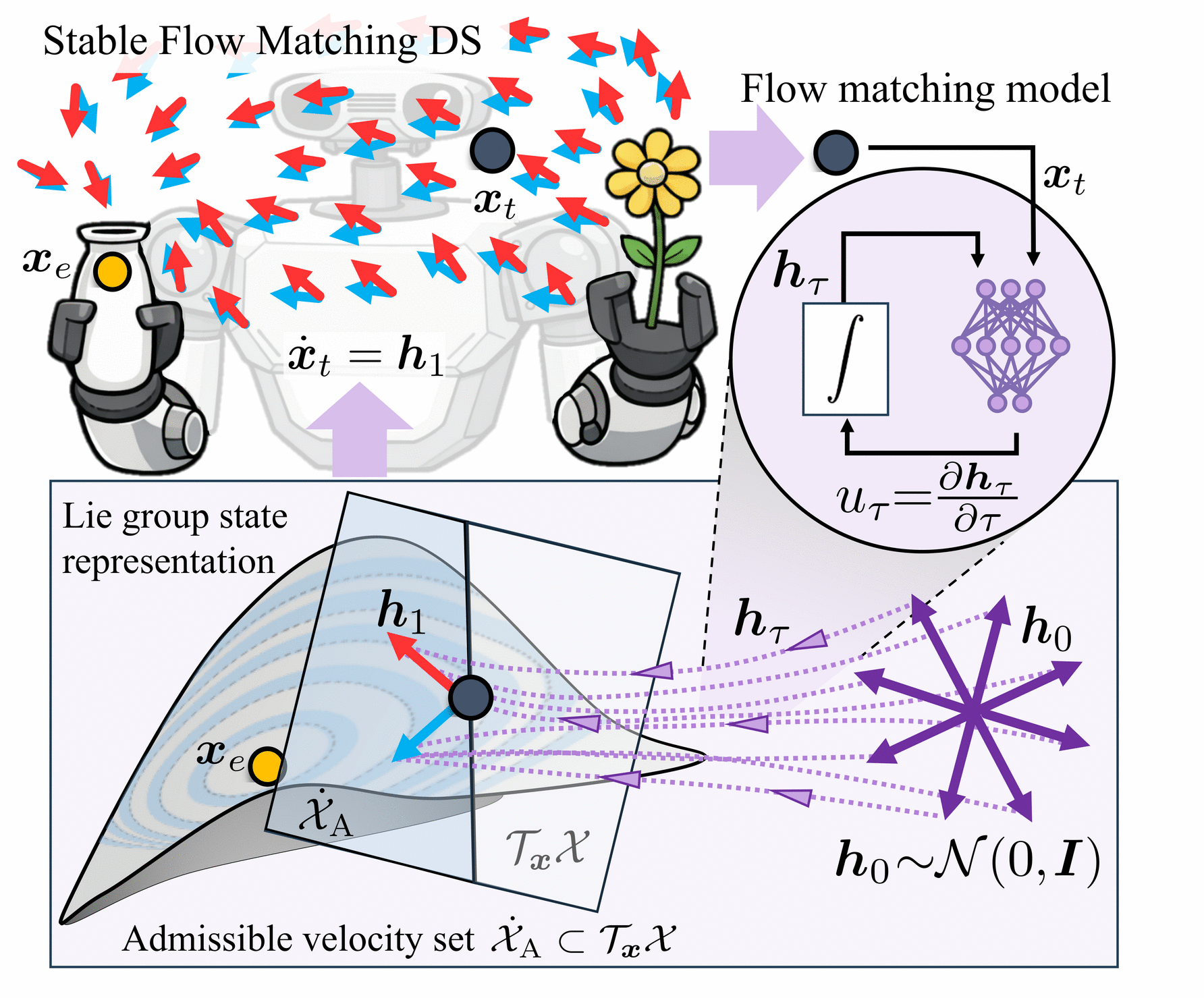
Robot behavior modeled as a stable flow matching dynamical system (SFMDS) on a Lie group. Velocities $\dot{\bm{x}}_t=\bm{h}_1$ learned via flow matching. Asymptotic stability is enforced by constraining the solution space of flow matching to a set of admissible velocities $\dot{\sX}_{\text{A}}$ derived from a latent Lyapunov function. SFMDS generates multimodal behaviors, represented by blue and red arrows.